
New SDI Release 2026.02.1098 Includes Improved VS 2026 Support
February 6, 2026Synergy/DE 12.1 Support Ending April 1, 2026
February 26, 2026

We’re excited to introduce DBL Talks, a new educational video podcast series designed to help DBL developers build stronger, more effective applications.
DBL Talks explores key DBL concepts through focused, code-driven discussions. Each episode walks through real examples, explains the “why” behind the syntax, and shows how the pieces fit together. The goal is simple: make it easier for developers to understand how DBL works under the hood and how to use it effectively in real-world applications.
We’ll be releasing episodes periodically, each focused on a specific topic. Today, we’re kicking things off with our first episode, “I/O Basics,” which focuses on the foundations of data access. Understanding how DBL interacts with data is critical for anyone building or maintaining data-driven applications, and this episode gives you a clear, practical starting point.
In this episode, we cover
- How channels work and why they’re the foundation of DBL I/O
- What ISAM (Indexed Sequential Access Method) is and how it supports both keyed and sequential access
- Core CRUD operations:
- Creating records with STORE
- Reading data with READ and READS
- Updating records with WRITE
- Deleting records using both soft deletes and hard deletes
- How locking works and why it matters for data integrity
- The differences between FIND and sequential reads
- Using partial keyed reads to efficiently work with ranges of data
Throughout the episode, we walk through live code examples to show exactly how these concepts work in practice.
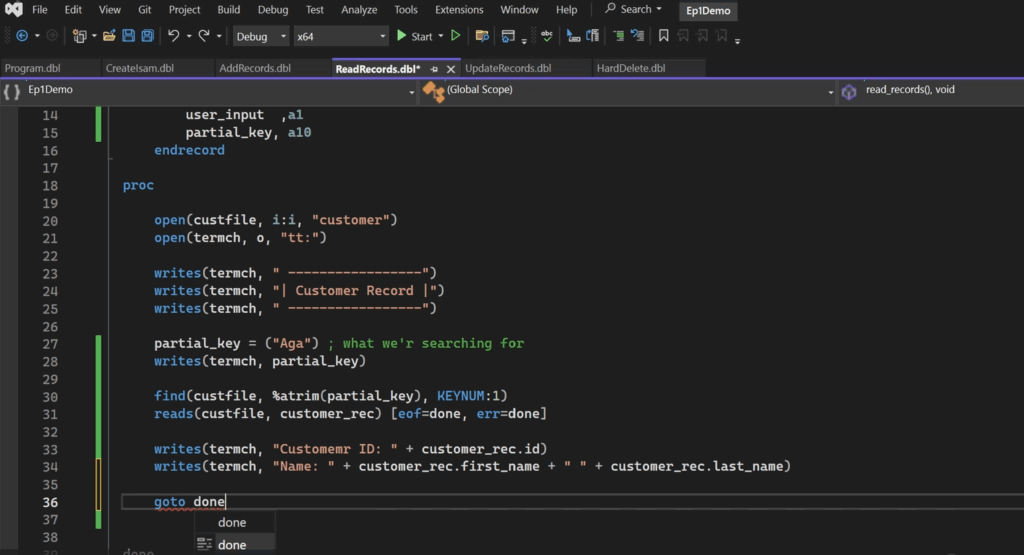
You’ll find links to the example code and relevant documentation in the video description to help you follow along or explore topics further.
This episode is ideal for developers who are new to Synergy DBL or who want a refresher on how DBL’s I/O model works before diving into more advanced topics.
Watch DBL Talks Episode 1: I/O Basics on YouTube.
What’s Coming Next in DBL Talks
Future episodes of DBL Talks will build on these fundamentals and explore more advanced DBL features, including
- The Select class for SQL-like querying of ISAM data
- I/O hooks and how they can be used to intercept and extend I/O operations
These upcoming episodes are geared toward developers who already have some experience with DBL and want to deepen their understanding of its more powerful capabilities.
Stay Connected
We encourage you to watch this first episode of DBL Talks and subscribe to our YouTube channel so you’ll be notified when new episodes and other learning resources are published.
If there’s a topic you’d like us to cover in a future episode, let us know! We’re very interested in hearing what the developer community would find most useful. Thanks for joining us for the launch of DBL Talks. We hope this series becomes a valuable part of your learning journey.