

DBL Talks Podcast Episode 2: The Select Class
April 1, 2026
A Grateful Farewell
April 14, 2026
It’s 1976.
Former Georgia governor and peanut farmer Jimmy Carter becomes the U.S. president, campaigning on ethics, honesty, and post-Watergate reform. The U.S. Bicentennial marks 200 years since independence, while Viking 1 lands on Mars. “Rocky” is the top-grossing film at the U.S. box office. Energy insecurity is global, and “stagflation” concerns persist. Early networking technologies, building on ARPANET, set the stage for future internet expansion. Advances in semiconductor manufacturing accelerate miniaturization and the affordability of electronics. Steve Jobs, Steve Wozniak, and Ronald G. Wayne co-found Apple Computer (on April 1).
Necessity, Meet Mother of Invention
Meanwhile, in northern California, two other tech entrepreneurs decide to ride the minicomputer wave. Established in the early 1960s by Digital Equipment Corporation (DEC) and followed by the 1965 release of its first “mass-market” system (the PDP-8), the minicomputer industry is taking off.
With minicomputers, organizations of all types can automate their critical business functions without the high costs of mainframe ownership or time-sharing. This potentially opens the floodgates for new, more affordable, and highly functional business applications.
During this time, two programming geeks attending UC Davis—chemical engineering major Ken Lidster and computer science major Michael Morrissey—team up to do applications consulting work on the side, a nice little business.
The two budding entrepreneurs join a small DEC OEM (then called DISC, for Digital Information Systems Corporation). DISC bundles complete solutions for a variety of local customers, packaging hardware, system software, and business applications such as general ledger and accounts payable. These applications are written in DIBOL—DEC’s powerful business-oriented language—and are based on a core suite of accounting modules developed by Mini-Computer Business Applications (MCBA). Business and life are good.
But OEM-ing DEC systems has its limitations. DEC is moving fast, continually updating its hardware, operating systems, and the DIBOL language itself. Each change forces existing DIBOL applications to be updated to stay compatible. This causes a lot of work for companies like DISC.
Lidster and Morrissey figure out how they can liberate their DIBOL apps from this DEC OEM “lock.”
Although it’s not their day job, working from DEC’s DIBOL manual, Lidster and Morrissey proceed to write (in assembly language) an independent business programming language named DBL. And it gets better from there.
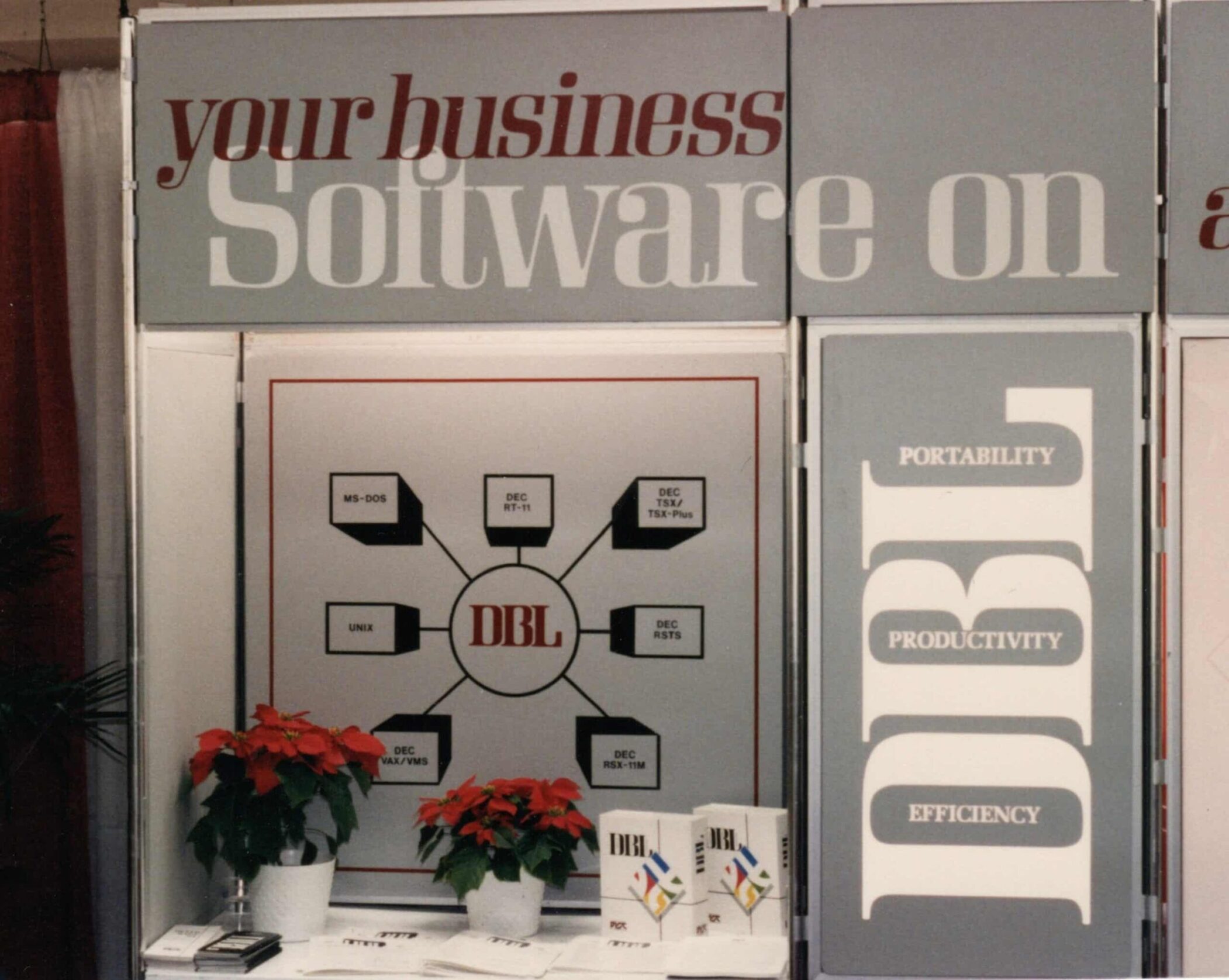
DBL: A Simple But Ingenious Plan
DBL (Data Business Language) eliminates the need to rewrite code every time DEC releases an update. It also enables OEMs to put together cheaper systems, as they don’t need DEC’s DIBOL kit. Other DEC OEMs and DIBOL application developers start asking DISC for DBL licenses. This dramatically changes the company’s trajectory.
At the time, DIBOL and DBL are available only on the PDP-11, and the only operating system for the PDP-11 is RT-11, a single-user system.
Two professors at the University of Tennessee, Harry Sanders and Phil Sherrod, had started a company to help tackle the single-user-system problem. Their TSX is a time-sharing system that runs “underneath” RT-11 and makes RT-11 a multi-user system. Lidster and Morrissey port DBL to TSX—enabling DIBOL/DBL applications to run on this platform, which is very popular with their growing application-developer customer base.
DISC sells a lot of TSX licenses. More importantly, this move to TSX lays the groundwork for DBL’s portability. Customers can now sell their enterprise business applications on emerging platforms!
Recognizing the opportunity ahead, Lidster and Morrissey steer DISC away from the OEM business and forge ahead as a language software company. “We knew that we could create a successful computer business—if we had the ability to run a business language on our systems,” says Lidster. “That language turned out to be DBL, and it made more sense to be a software company. We were software guys. We knew.”

By the late 1970s, DISC adds an ISAM database and other features to their growing language. DBL will soon become a viable DIBOL alternative, aimed at business application developers worldwide serving a wide range of vertical markets.
In the ‘80s, DISC rewrites DBL in C and makes it possible to migrate applications to then-emerging VMS, Unix, MS-DOS, and Novell Netware systems. In the ‘90s, it enables migration to Windows.
Next, the floodgates—customers’ applications—open. Customers want to take advantage of emerging technologies and tools. The company’s roadmap shifts to opening access to Synergy applications and data and to enabling integration with other systems. Focus is on preserving the back-end business logic and data (where customers’ big investment is), enabling access to these from other front ends, including the web and Windows clients, and providing connectivity to popular RDBMSs.
Today, customers are integrating with and creating web services, migrating to .NET, and leveraging streaming integration to adopt distributed architectures and integrate AI.
Where next?

A Pacesetter for Today
The company (renamed Synergex International Corporation in 1996) continues to evolve DBL and their expanded toolset. Current versions are supported on Windows, Linux, Unix, AIX, and OpenVMS.
Synergex continues to lead customers to modern solutions, opening their applications and data to new technologies and standards and empowering their businesses in new ways.
As a company, Synergex distinguished itself early with its customer-driven approach and its commitment to the highest level of customer service. Decades-long relationships with customers and tenures for employees tend to be the rule not the exception.
“Throughout its history, Synergex has believed that customers should be able to focus on the business functionality of their software—where their expertise lies,” explains Lidster. “It’s Synergex’s job to provide a seamless interface between operating systems and applications so that customers are insulated from the system-level technology as much as possible.”
Retiring president William (Bill) Mooney first joined Synergex in 1983 as a salesperson, left briefly and returned in 1985 as sales manager, then went on to help build the enduring customer relationships that have sustained the company for four decades. Throughout his tenure—including 14 years as president and more than 8 years as CEO—Bill has consistently advocated for customers and reinforced a core principle that has defined Synergex: protecting and extending the life of customers’ applications as technology evolves.
“I’ve always believed that the true measure of Synergex’s success is the longevity of our customers’ applications,” says Bill. “This conviction guided key decisions over the years, even during times of uncertainty, to ensure customers could move forward without abandoning what they had built. That vision continues to guide the company today, ensuring that customer applications will not only remain relevant but will also continue to thrive well into the next century and beyond.” Bill retired in April 2026 after 40 years of dedicated service to Synergex and its customers.
New president Neithard (Neit) Foley joined Synergex in October 2025 and officially assumed the role of president in January 2026.

A Vision for Tomorrow
Opportunities continue to abound today in the Synergex universe, keeping pace with customers’ business challenges, industry shifts, and developers’ imaginations.
For example: with Synergex’s Streaming Integration Platform (introduced in 2025), customers are achieving high-performance, real-time data replication using Kafka-compatible technologies, paving the way for more modernization, cloud migration, and seamless integration with AI technologies.
And while DBL applications are well-positioned for the future, so are DBL developers. Synergex continues to advance its toolset to maximize productivity and deliver an optimal developer experience. For example, the company regularly enhances its DBL integration with Visual Studio and is developing a static code analysis tool to help customers evaluate and improve their code bases. Imagine being able to automatically detect bugs and vulnerabilities in your software so you can improve the overall quality, security, and reliability of your system.
From its current home base in Gold River, California, Synergex today serves customers worldwide across many industries. Its original side project has grown—shaped by customer needs and evolving technology—to help customers preserve and protect their complex, business-defining applications.
For 50 years, Synergex has worked closely with customers to keep pace through massive business and technological changes. This has helped customers
Preserve their code bases.
Protect their applications, IP, and futures.
Pursue new business ideas without a heavy “technology tax.”
Propel their businesses by continually incorporating the latest industry-standard tools, technologies, and expertise.
“As Synergex’s new president, I’ve been amazed by the foundation built over the past 50 years—a foundation shaped by trusted partnerships, technological evolution, and a deep commitment to customer success. It’s an honor to join this team at such a meaningful milestone. I’m enthusiastically learning from our customers as we build on that legacy and continue earning the trust they’ve placed in us for five decades.”—Neit Foley, president, Synergex.
In the coming weeks of our 50th anniversary year, you’ll read more stories here about Synergex’s decades of innovation, growth, and partnership.
Here’s to the next 50 years.
